


Materials Center
A Democratic Approach to Learning Head, Hands and Heart
The Materials Center is an initiative of Emergent Inquiry Studio that explores how reclaimed, recycled, and everyday materials can become catalysts for democratic learning, creativity, and climate-conscious education.
Supported by the Harvard Graduate School of Education and Harvard Innovation Labs, the project reimagines what learning materials can be and who has access to them.
500+
children
repurposed
500+ kg
waste
impacted
ART CREATIVITY PLAY CRITICAL THINKING SOCIAL EMOTIONAL LOOSE PARTS AGENCY REFLECTION COMMUNICATION CHILDREN LEARNING

Reimagining Learning
The Materials Center is a research and community initiative of Emergent Inquiry Studio exploring how access to open-ended materials can support democratic learning, creativity, and climate-conscious education.
Supported by the Harvard Graduate School of Education Entrepreneurship Grant, the project emerged from a simple observation: while schools often invest in standardized learning resources, children rarely have access to diverse, open-ended materials that invite exploration, experimentation, and collective problem-solving. The STEM kits available in the market are expensive and product focused.
At the same time, large amounts of usable industrial, commercial, and household materials are discarded every day.
The Materials Center seeks to connect these two realities.


Why This Work?
We believe that materials are not neutral. They shape how children think, create, collaborate, and participate in learning.
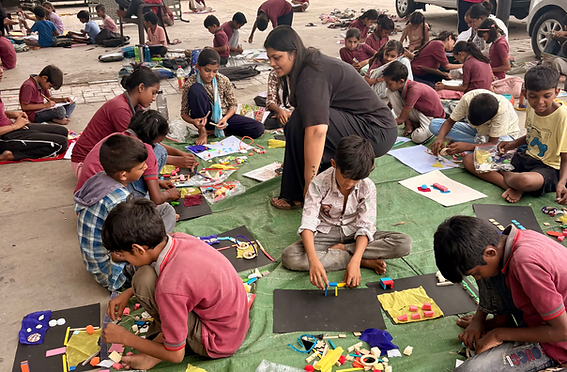
When children work with open-ended materials, they are invited to make decisions, test ideas, negotiate with others, and imagine possibilities. These experiences support democratic learning by positioning children as active contributors rather than passive recipients of knowledge.
The project also responds to growing environmental challenges by encouraging reuse, repair, and creative engagement with materials that might otherwise become waste.
Rather than teaching sustainability as an abstract concept, we invite children to experience it through making, designing, building, and reimagining resources.

What We Are Doing
The Materials Center is currently being developed through partnerships with children across Ahmedabad, India, including:
-
Government schools
-
Low-income community settings
-
Out-of-school learning environments
-
Private schools
Working across these different contexts allows us to explore questions such as:
-
How does access to materials influence children's creativity and participation?
-
What kinds of inquiry emerge when children are given greater agency over how materials are used?
-
How can reclaimed materials support equitable access to rich learning experiences?
-
What role can materials play in helping children think about environmental responsibility and sustainable futures?
Alongside children, we are documenting learning, observing patterns of engagement, collecting stories, and developing frameworks that can support educators and communities in creating more material-rich learning environments.
Current Areas of Exploration
Our curriculum isn't a fixed sequence of lessons — it's a connected map of inquiries, organized around the question: how can materials help us observe, imagine, create, and understand the world around us? Right now, children across our partner classrooms are exploring:
-
Self & Identity — portraits, self-representation, and personal stories built with flat loose parts
-
Structures & Building — houses, shelters, and 3D construction that bring together balance, geometry, and design
-
Systems & Place — maps, neighbourhoods, and the infrastructure of the communities children know
-
Light, Shadow & Reflection — transparency, colour, and changing forms using reflective and translucent materials
-
Culture & History — festivals, historic buildings, and the traditions and places that matter to children
-
Nature & Phenomena — rain, growth, habitats, and environmental change, observed and represented in materials
Each theme is designed so that mathematics, literacy, science, art, and social learning emerge together, rather than as separate subjects.


Our Hope
Our long-term vision is to create a community-based ecosystem where materials circulate rather than being discarded, and where children, educators, families, and organizations have greater access to resources that support creativity, inquiry, and participation.
We hope to demonstrate that sustainable materials can be powerful educational resources, that democratic learning can emerge through making and collaboration, and that children can play an active role in imagining more just and sustainable futures.
The Materials Center is not simply about collecting materials. It is about creating new possibilities for learning, participation, and environmental responsibility through the materials that surround us every day.
Report
Email us to read the complete report


